Your Cart is Empty


The rise of the samurai and their move of the Japanese center of government from Kyoto to Kamakura in the 12th century had a significant impact upon the art of incense. Without the influence of Kyoto’s Imperial Court or its Buddhist sect politics, Kamakura Shin Bukkyō (鎌倉新仏教, Kamakura New Buddhism) flourished in the samurai's bakufu capital. Key among these new forms of Buddhism were forms of Zen founded by Myōan Eisai and Eihei Dōgen. Zen placed importance on the intuitive transmission of enlightenment rooted in the Flower Sermon of the Buddha. Unlike many other sermons in which the Buddha taught with words, during the Flower Sermon, the Buddha remained silent and only held up a lotus flower. None present understood this teaching except one disciple, Mahakasyapa, who smiled in response, demonstrating the Buddha’s teachings went beyond words and letters intuitively. The difficulty of putting into words Zen’s intuitive teachings was similar to the way fragrance was intuitively perceived, creating a closely interwoven relationship between Zen and incense, leading to Zen promoting the use of incense as a direct companion of spiritual practice.
In its flagship fragrance, Minorien's Chōkō Go-Ban (調香五番, Fragrance Blend No. 5) presents a picture of kyara through both its exquisite fragrance as well as through just such an intuitive experience that represents, to paraphrase Dōgen, kyara's fragrance beyond fragrance. Hailed as Minorien’s most luxurious fragrance, Chōkō Go-Ban is made completely from natural fragrant woods aged to mellow perfection, reflecting the finest nature of rare fragrant kyara. Packaged in a surprisingly humble box, just as with the lotus flower held up by the Buddha, what lies beyond the package far exceeds its simple outward presentation.
Chōkō Go-Ban's unlit stick is sharp, with subtle stone and turpentine notes blending with a light earthy sweetness. The milk-chocolate brown stick is rich, deep, and light with a cologne-like effervescence, potent and energetic, yet soft and sweet spice notes mingle amid the boisterous evaporation of its base. Mixing notes of leather and the bygone antiquity of an old garage with a soft sweetness like the home of a long married couple, the unlit stick blends the sweetness of subtle spiced perfume mixed with well worked wood polished by time. The unlit stick's profile is unusual, hinting at something exceptional to come, like the teachings of the Buddha without the use of words.
Alight, Chōkō Go-Ban begins with a deceptively soft sweetness filled with warmth and light. From the very start, its fragrance presents as transparent, almost gauze-like, with a light sweetness that is welcoming, peaceful, and calming. The term "sweetness" is used here as more of a placeholder, as although its common meaning applies, Chōkō Go-Ban's sweetness is ethereal, as if filled with a feeling of shafts of light passing through the morning fog soft and transparent. In time notes of rich caramel mixed with a light floral fruity sweetness develop, but always in service to the lighter overall sweet warmth that continues far above.
As the incense expands, a powdery toasted quality develops to its sweetness, returning the notes of turpentine and stone first hinted at in the unlit stick. Here the sweetness takes on a pointed quality, playing up hints of leather with sharper turpentine-like pine resin overtones, mixing ancient wood and earth amid soft woody floral notes. As the incense continues to fill the space, this sharpness of tone focuses Chōkō Go-Ban's sweetness, while at the same time providing a firm base upon which its more ethereal notes rest.
The result is a hypnotic depth that both soars with an airy ethereal quality, yet is firmly grounded with rich earthy tones exemplifying the beauty of the rarest kyara. This extraordinary nature creates a difficulty describing Chōkō Go-Ban, as the fragrance has a presence that is more than words and letters can faithfully reproduce, its fragrance transmitted in a way reminiscent to the lotus flower held up by the Buddha whose meaning was recognized with noting but a smile of enlightened awareness. This is the beauty of Chōkō Go-Ban; it transcends its fragrance with a rich beauty beyond description that can only be intuitively experienced.
Chōkō Go-Ban's after-note turns decidedly more earthly, with many of the sharper resinous notes of the unlit stick moving to the fore, giving it a rich loamy presence that remains like a realization's introspection. Filled with the sweet notes of turpentine and leather, Chōkō Go-Ban lingers in the air with a masculine presence like that of aged wood of a well worn walking stick of a great master. Over time the fragrance wanes, becoming more woody as it vanishes from awareness, the feeling of ancient wood and the wisdom of nature blending like the ancient trees of Dōgen's Eihei-ji left in the wake of its long lasting after-note.
Filled with aged natural woods highlighting the intuitive beauty of the rarest kyara, Minorien's Chōkō Go-Ban is filled with a ethereal sweet warmth floating over an earthy woody base. It is a delightful fragrance for the aloeswood connoisseur that goes intuitively beyond description of mere words and letters.
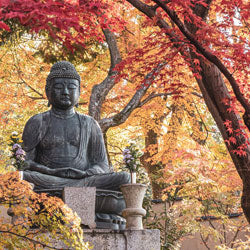
The bay in the distance,
fall colors framing the view.
A beauty exceeding words.

Minorien Chōkō Go-Ban is available in the following size:
15-Stick Box
****
Learn more about how Zen influenced the refinement of the Japanese art of incense in the book: The Fragrant Path: A Guide to the Japanese Art of Incense. Filled with practical suggestions, useful tips, and an exploration of the history, selection, use, and appreciation of this uniquely Japanese art form, The Fragrant Path offers a rare, comprehensive look into the Japanese art of incense in the first in-depth English-language book on the subject in nearly three decades.